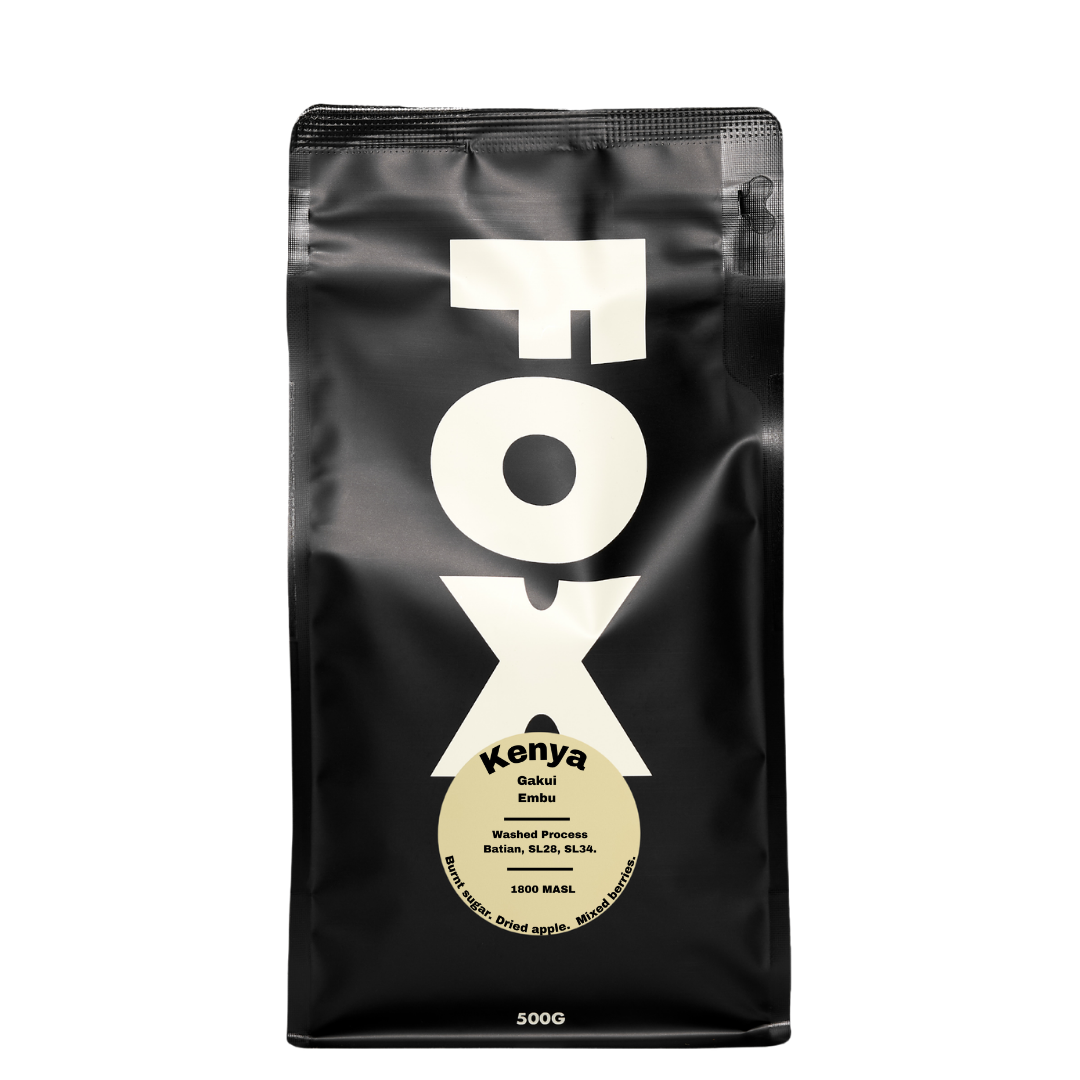
Kenya Gakui (Espresso)
Kenya Gakui (Espresso)

The Gakui factory sits at 1,800 metres above sea level on the slopes of Mount Kenya, in the foothills of Embu County — one of Kenya's most celebrated growing regions, fed by six rivers and two rainy seasons. This is a Peaberry lot: a natural mutation where a single bean develops inside the cherry instead of the usual two, concentrating flavour into a smaller, rounder, denser package.
In the cup: burnt sugar, dried apple and mixed berries. Complex, vibrant acidity with candy-like sweetness that lingers long after the last sip.
Classic Kenya. No apologies. No compromises.
Let us help you brew this. Like having a barista in your kitchen. [No Bad Coffee Club →]
Flavour notes
Burnt Sugar. Dried Apple. Mixed Berries.
Washed process. Peaberry lot. Complex acidity. Candy-like sweetness.
You've got questions, we've got answers.
What is a Peaberry and why does it matter?
Normally, a coffee cherry contains two beans facing each other. Occasionally — in around 5–10% of cherries — only one bean develops, growing rounder and more concentrated than a standard flat bean. This is a Peaberry. Because the single bean absorbs all the nutrients the cherry has to offer, many roasters and buyers find them more intense, more complex and more vibrant in the cup. Not a guarantee — but in the right hands, with the right processing, they're remarkable. This is the right hands.
What makes Kenyan coffee taste like this?
Two things: variety and process. SL28 and SL34 are two of the most prized coffee varieties in the world, developed in Kenya specifically for this terroir — they're the reason Kenyan coffee has that signature bright, complex, fruit-forward acidity that no other origin quite replicates. The processing at Gakui adds another layer: after fermentation, the beans are soaked in clean water for up to 24 hours — a uniquely Kenyan step that allows amino acids and proteins in the bean to develop, directly contributing to the complex fruit flavours Kenya is famous for.
Who produces this coffee?
The Gakui factory — built in 1996 — is part of the Gakundu Farmers' Cooperative Society and processes cherry from hundreds of smallholder farmers, most of whom own less than half a hectare of land. Every harvest, those farmers deliver their cherry to Gakui, where it's sorted, pulped, fermented in two stages, washed and soaked before going to raised drying tables for 5–10 days. The cooperative also pre-finances school fees and farm inputs for members from the previous harvest's earnings — this is coffee that funds education.
Is this espresso or filter?
Filter is where it shines. The dried apple and mixed berry character open up beautifully at longer brew times — V60, Kalita, Aeropress and batch brew will all do it serious justice. The burnt sugar sweetness and complex acidity are exactly what filter coffee at its best should taste like. Adventurous espresso drinkers who love a bright, fruit-forward shot will find plenty to love here too, but filter is home.
Will it be too acidic?
Kenya has a reputation for brightness and this one earns it — but it's complexity, not sharpness. The acidity is balanced by the burnt sugar sweetness and berry depth, not fighting it. If you've had a Kenyan coffee before and loved it, this is exactly that. If you're new to Kenya, this is a very good place to start.
Roasted fresh, shipped fast.
Roasted five days a week, dispatched daily before 1pm. Every bag stamped with the roast date — because a Peaberry microlot this carefully produced deserves to arrive in your hands at its absolute freshest.
No grinder? No worries.
Choose your brew method at checkout and we'll grind to suit. Filter grind recommended for this one.
Origin: Kenya
Region: Embu, Mount Kenya
Factory: Gakui — Gakundu Farmers' Cooperative Society
Variety: Batian, SL28, SL34, Ruiru 11
Grade: PB (Peaberry)
Process: Washed
Altitude: 1,800 MASL
Harvest: October – December
Notes: Burnt Sugar, Dried Apple, Mixed Berries
Home espresso machine, Plunger, Stovetop, Coldbrew, Clever dripper
Don't just take our word for it.
Couldn't load pickup availability